

Hey Swimmers,
Last week’s blog, “It’s Really Not That Hard!”1, really seemed to strike a chord.
We’ve had hundreds of swimmers get in touch by email and through our social channels to say thank you for the clarity around how to use the Tempo Trainer PRO, and more importantly, not to be afraid to get it out of their kit bag and actually use it.
What’s been especially pleasing is hearing that many of you have taken that article straight back to your regular social swimming groups and started encouraging your buddies to join you on a swim using the beeper. That is brilliant. But of course,
there is a catch. Concepts like CSS and Red Mist cycles can still sound pretty alien to the uninitiated. So no matter how much we talk about the virtues of training with objective pacing, and no matter how excited you become about the rationale, there is still going to be a learning curve for your mates.
But don’t fret. This is exactly why I’ve been fastidiously writing this blog every week for over 20 years: to educate, simplify, and spread the word about how to improve the time you spend swimming. If you found last week’s article useful, the best thing you can do for yourself, your training partners, and for us, is simply share it in your WhatsApp group or wherever your swimming tribe chats away off deck.
Get a discussion going. When everyone arrives with just a little more understanding of why you are doing what we suggest, everything flows better. Sometimes it’s hard for us to know quite how much this work is helping, but if you want to support our mission of helping the world swim better, sharing our work with your mates is one of the best things you can do. Thank you 🙏.
Lessons from the Tour de France

The title of this week’s blog comes from one of my favourite sporting voices of all time: Phil Liggett commentating on the Tour de France.
Every year, as the race heads into the Alps and Pyrenees, the peloton starts to split apart and some crestfallen hero inevitably gets dropped on a steep climb. Liggett, in those wonderfully measured tones, often points out that the best thing that rider can do now is not fight the fact they have been dropped, but simply settle into their own best steady tempo and limit the losses.
Damage control. Composure. Keep moving forward.
I think about this a lot with my own swimming.
When the Pace Starts to Slip
The very nature of training at or around your CSS pace is that you are eventually going to get to a point where you are not quite sure if you can keep making the targets. A little like the Tour de France rider on a long climb, you may start to fall off the pace. So what do you do? Panic? Give up? Or recognise one of three things?
1. Adjust the Target, Not Your Confidence

First, perhaps your CSS pace is just a little too fast. The fix is simple: use the CSS Tweaker in the Swim Smooth GURU and dial it back a smidgen after the session. Over time, this helps you narrow in on where you actually are. Equally, if you are constantly beating the beeper, it might be time to stretch yourself a bit and tweak things the other way.
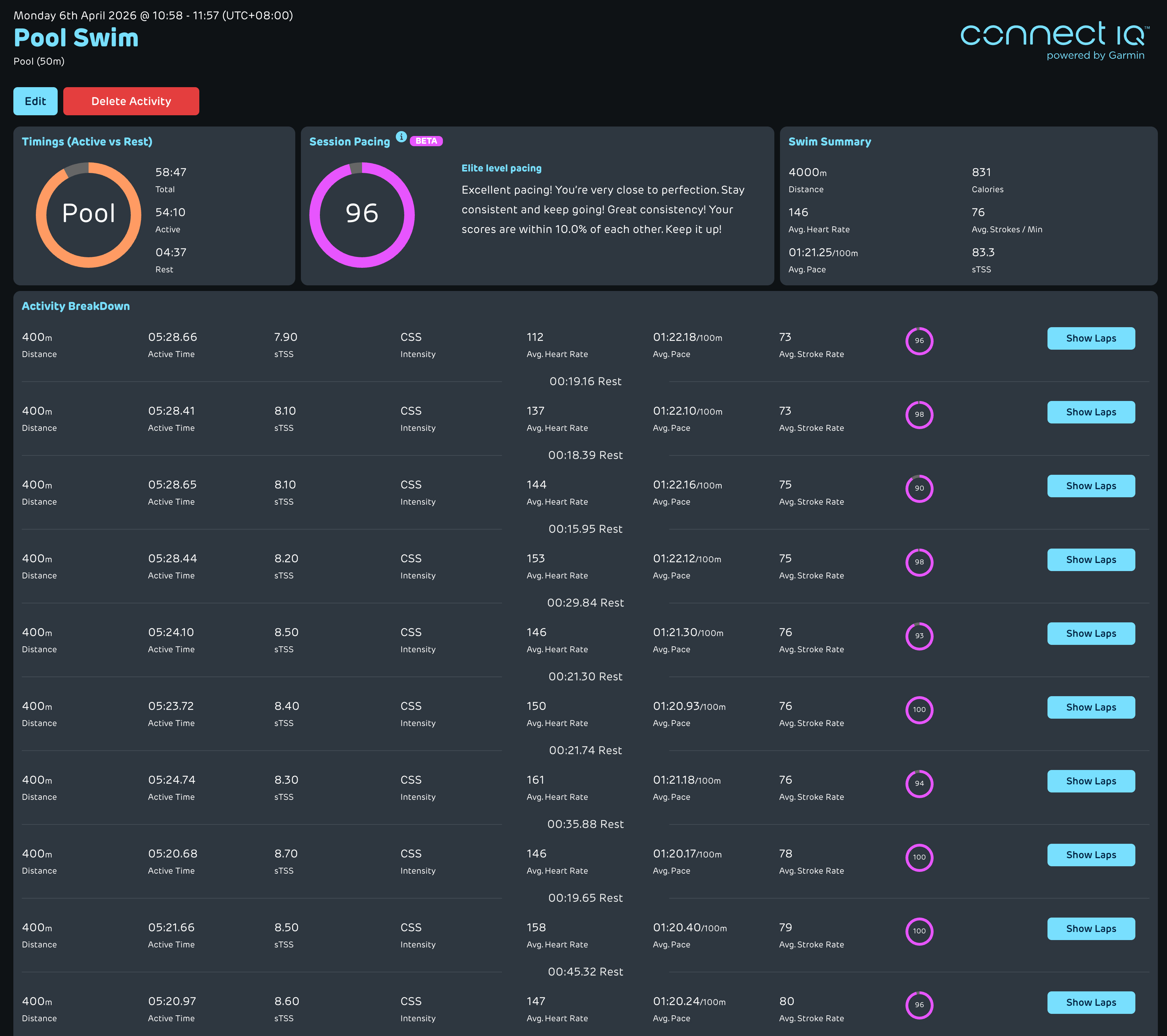
This week I started all flamboyant, knowing I’m racing at Best Fest in Mallorca in six weeks’ time. Unashamed plug: we’ve now got a Get Fit Quick Training Plan specifically for Best Fest in the GURU.

With that in mind, I decided to do my 10 x 400 based off 1:16/100m long course pace. I made the first 8 x 400 perfectly, missed number 9 by 1.5 seconds, and number 10 by 6 seconds. My initial response was disappointment. But when you stop and think about it, missing the targets by less than 8 seconds over 4000m really is not that bad. Nonetheless, I dialled my CSS back to 1:17/100m for Wednesday’s CSS session.
2. Manage Fatigue Like a Pro
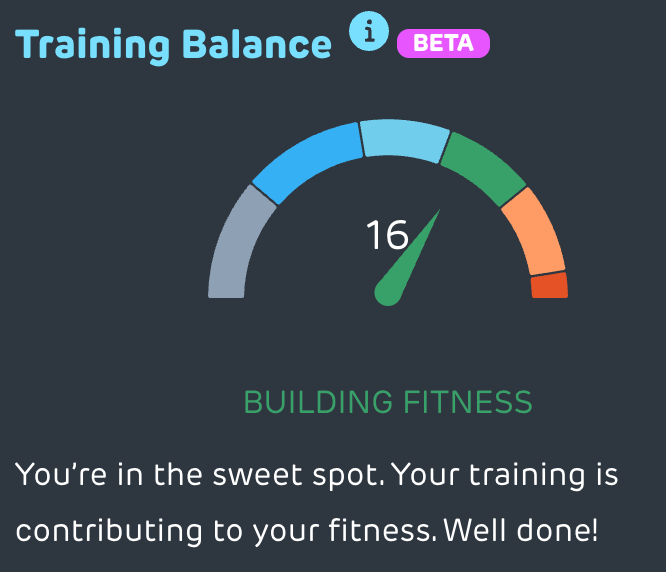
Second, perhaps you’ve just been training hard and you are a little flat today. That’s ok. Despite everyone’s penchant these days for calling each other a “legend”, sometimes you’re not, and that is perfectly fine.
This is where you need Phil Liggett’s damage-control mindset and a bit of resilience.
With the same enthusiasm for Best Fest, my last seven days have looked like this:
Thursday, 3.4km hard CSS session;
Friday, rest day;
Saturday, 4.0km open water in amazing conditions and at a good pace;
Sunday, 4.0km on the same course but in terrible conditions and three minutes slower;
Monday, 10 x 400 off 1:16;
Tuesday, 5.0km in some rather sharky waters at exactly the midpoint pace between Saturday and Sunday’s swims;
Wednesday, 3.0km Goldilocks CSS set.
That’s 23.4km of very solid swimming in seven days. No world records, obviously, and a lot less total volume than many of my peers, but a training week I’ve been very happy with.
It also featured the hardest session last: Goldilocks based off 1:17/100m. Did I make all the times? No. I missed the 300, Momma Bear, by 1 second and the 400, Daddy Bear, by 3 seconds. Was it a fail? No. I’m just a bit tired, as you’d expect. Had I not tweaked my CSS after Monday, I suspect I would have been much further off the pace and much more negative about the session. Instead, I went in knowing it would be tough, dialled the expectations back just a touch, and followed the advice of the great Phil Liggett: settle into your own tempo on that given day.
3. Know When to Step Away
Third, perhaps you are just having an off day and are not in the mood. It happens. Go treat yourself to a coffee and a muffin and come back next time. Again, you’re not a “legend” every day.
Timing Matters: A Lesson from the Pool
That theme came back to me again this week while swimming my Goldilocks set at one of my favourite pools, the Mandurah Aquatic Centre in Western Australia. I was sharing a lane with a gentleman wearing flippers and a snorkel in the “fast” lane, swimming about 2:30/100m. I’d just started my main set of 4 x 100, 1 x 200, 4 x 100, 1 x 300, 4 x 100, 1 x 400 off 1:17/100m with 15 seconds rest between each interval when he removed his snorkel and, during one of my 15-second breaks,
he proceeded to tell me that I had a major problem with my leg kick, namely that my right leg wasn’t working!
He somehow squeezed all of that in between my first set of 100s.
All I could do was politely thank him for his observations and carry on. The trouble was, it was then all I could think about for the next 600 metres. Was he right? Maybe. Could his observation help me? Perhaps. Was it the right time to deliver it? Absolutely not.
Why Structure and Context Are Everything
This is one of the fundamental philosophies I share with our coaches. Give detailed, expert advice, of course, but only at a time-appropriate opportunity, not in the middle of a CSS development set when the swimmer’s focus needs to be on pacing, composure and execution. This is precisely why every Swim Smooth session has a clear purpose, whether that’s Pure Technique, Red Mist Endurance, or something else, and why we outline the type of feedback you’re likely to receive during that session.
Of course, this gentleman was almost certainly just trying to be helpful, but given where my focus was at, it was anything but. And for that very reason, you’ll rarely hear me give a big technical pointer during a key set. During a Pure Technique session, absolutely. But during a high-focus CSS set, much less so. This is exactly why we and our coaches offer dedicated 1-to-1 video analysis and stroke correction sessions. They give you the time, headspace and structure to properly dissect your stroke, understand what needs changing, and then work on that correction with intent. It is far more beneficial, and it makes the tiny reminders we do give on pool deck during harder sessions far more meaningful and easier to understand than a random call of, “You’ve got a real problem with that right leg of yours!”
Settle Into Your Tempo
So, when you fall off the pace, and you will, don’t panic. Settle into your tempo, be honest about why it is happening, and keep moving forward. That is where real progress is made.
Thanks for reading, your coach, Paul.

