

Hey swimmers,
Last week’s blog, “I Spend More Time Slowing People Down Than Speeding Them Up”1, generated plenty of discussion.
I write these blogs on a Thursday before our biggest day on the pool deck (Friday) which features two back-to-back CSS Development Sessions (we call them “Fresh ‘n’ Fruity”), a 5km Red Mist Endurance Session and then some lucky punter gets to do a 1-to-1 video analysis session to round off the week, focusing on their technique. Given this, I can always be assured that I will get some comments on a Friday morning about what I wrote on a Thursday. Last week was no different - Will, one of our lane 3 swimmers with a CSS of 1:28/100m, pulled me aside and playfully said:
“I was going to call bullsh*t on your post yesterday! You NEVER spend time slowing me down…in fact you only ever push me forwards!”
What I gently reminded Will of, however—and I hope it was both reassuring and a well-deserved pat on the back—is that he's one of those swimmers who simply gets it. He understands the rationale behind the pace targets. He knows when to hold back and when it's the right time to push. As a result, it probably does feel to him that I'm always encouraging him to move forwards. And that's because I can. He's put in the work. He's built his engine. He's learned how to pace himself properly, week after week and session after session. Those foundations now give him the confidence and fitness to keep progressing. It's no coincidence that he's been one of our most improved swimmers over the last six months.
When you train like Will, you earn the right to push forwards. Those foundations allow you to take on harder sessions with confidence because you've developed the discipline to train at the right intensity on the right days. For swimmers who haven't quite embraced that approach yet, progress can often be slower than it needs to be. That was really the message behind last week's blog: a gentle call to arms for anyone who would benefit from introducing a little more structure into their training. It's certainly a lesson I've had to learn myself over the years, too.
Will’s sportive comments aside, for many of you, the message really resonated. Using tools like the FINIS Tempo Trainer to hold specific paces removes much of the guesswork from training. Instead of simply swimming “easy”, “moderately hard” or “hard”, you have an objective target that helps ensure you’re working in the right physiological zone for the session. It provides a framework for measuring progress rather than relying solely on feel.
Not everyone agreed, however.
A few readers questioned whether introducing too much objectivity risks taking away some of the freedom and joy that makes swimming so appealing in the first place. It’s a fair point. Most of us started swimming because we enjoy it, not because we wanted to stare at numbers all day.
For me, though, the numbers are never the goal. They’re simply a compass.
Without some meaningful way of measuring your training, it’s a little like firing a scattergun into the darkness. You can put in plenty of effort, but it’s difficult to know whether what you’re doing is actually moving you closer towards your goals. A handful of objective sessions each week provides direction, while still leaving plenty of room for those wonderful swims where you simply switch off and enjoy being in the water.
That brings us neatly to this week’s topic.
One of the biggest advantages of tracking your training over time is that it allows you to see not only how fitness develops, but also how quickly it can disappear and, perhaps more importantly, how long it really takes to come back.
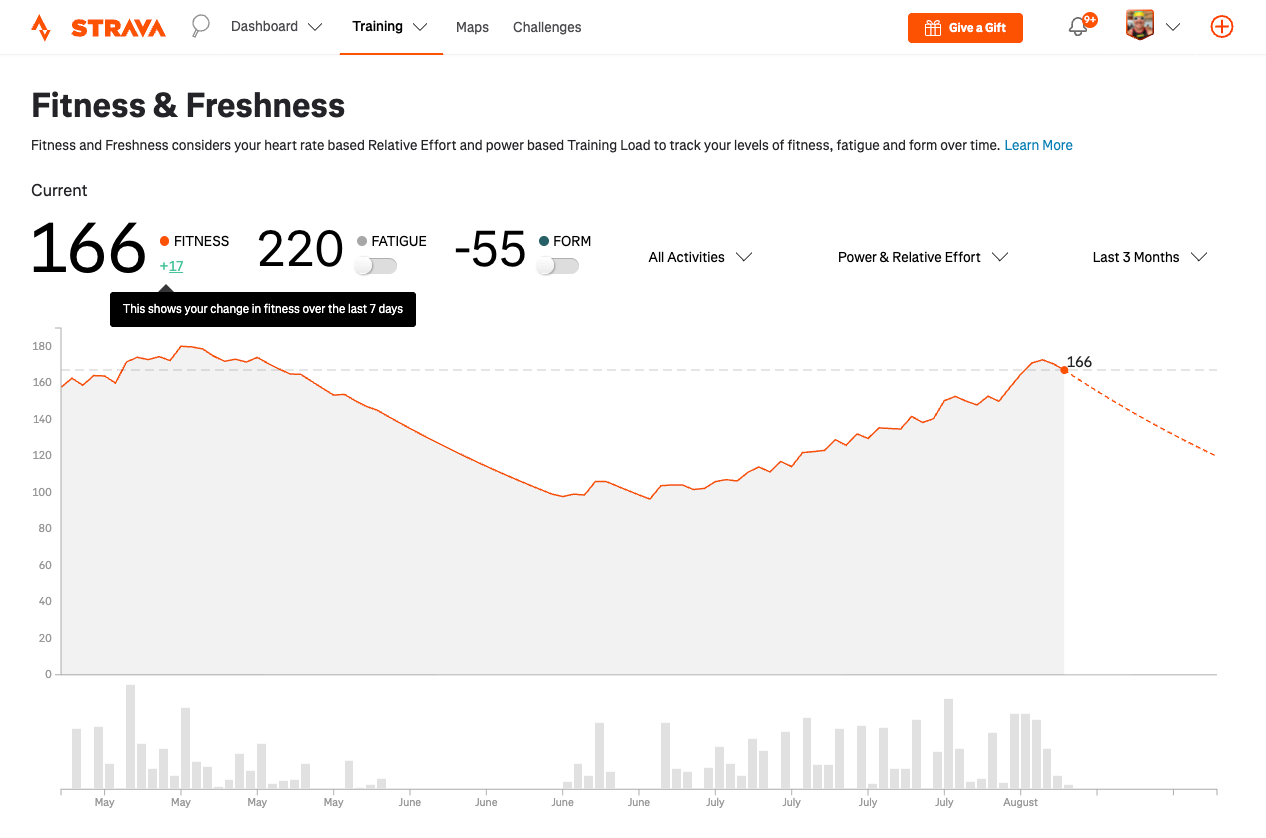
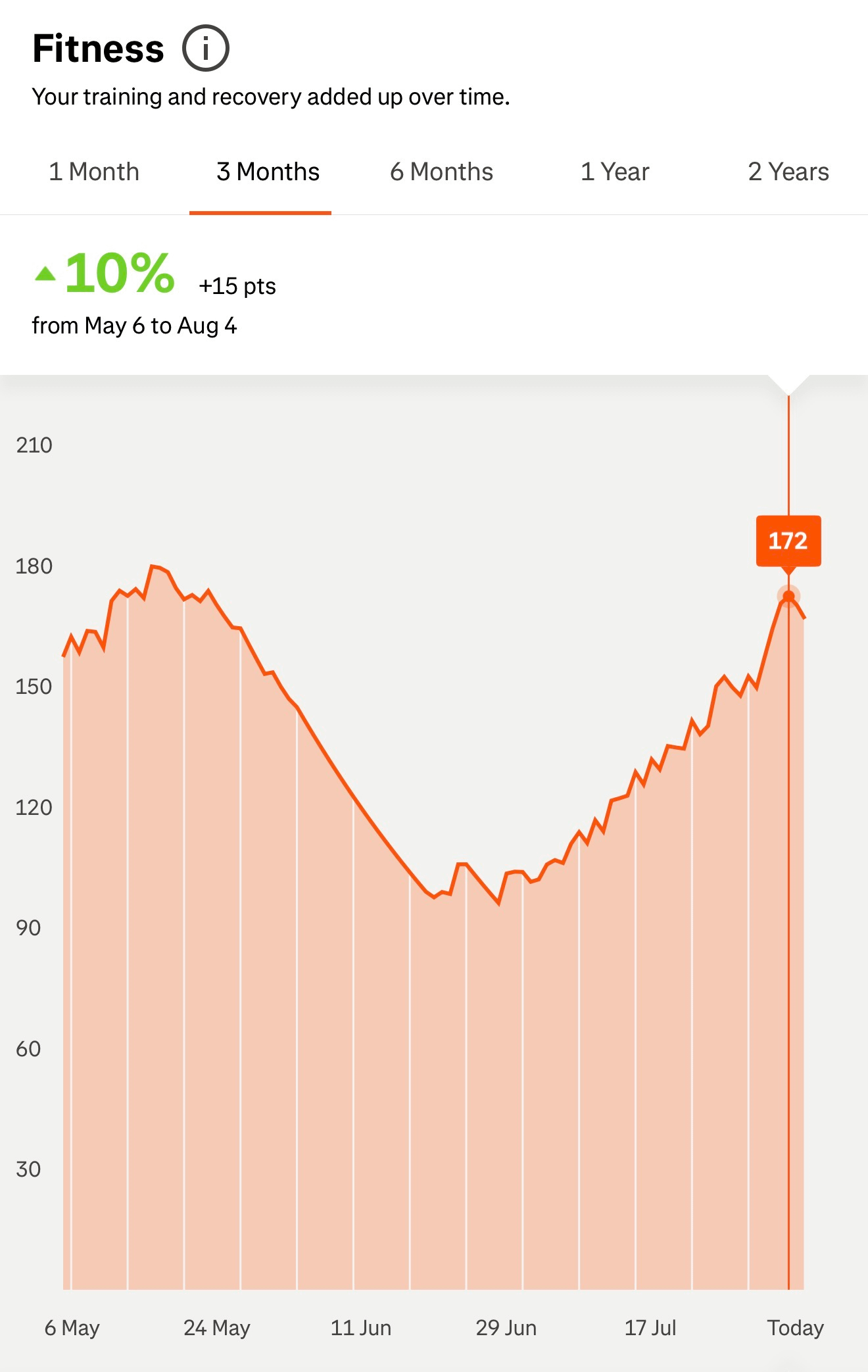
Whilst it certainly wasn’t enjoyable watching my own fitness curve fall away so dramatically after Best Fest Mallorca 2026, following a month of illness, there has been something quietly satisfying about watching it steadily climb again. The daily improvements are small, almost imperceptible, but together they tell a reassuring story: consistent training, even after a setback, always moves you back in the right direction.
The chart below illustrates exactly what I mean.
“Fitness is hard won and easily lost.”
It’s an old saying that every endurance athlete has heard, but until you actually see it plotted in front of you, it’s difficult to appreciate just how true it really is.
In May, I reached one of the highest levels of swim fitness I’ve enjoyed in years, culminating in winning the overall title at Best Fest Mallorca 2026. After the event, I stayed on to coach our Swim Smooth camp before unfortunately picking up an illness that kept me out of the water for almost four weeks.
The result was a dramatic drop in fitness.
What struck me wasn’t simply how quickly my fitness declined during that month, but how much longer it has taken to rebuild it. Even now, around six to seven weeks after returning to training, I’m still not quite back to where I was before getting sick.
The recovery curve is noticeably shallower than the decline.
A rough rule of thumb from my own experience this time around has been a 4:6 ratio. Four weeks lost through illness has required around six or seven weeks of consistent training simply to approach my previous level again. Everyone is different, of course, but it’s a useful reminder whenever life interrupts your training.
Quantifying Your Different Types of Training
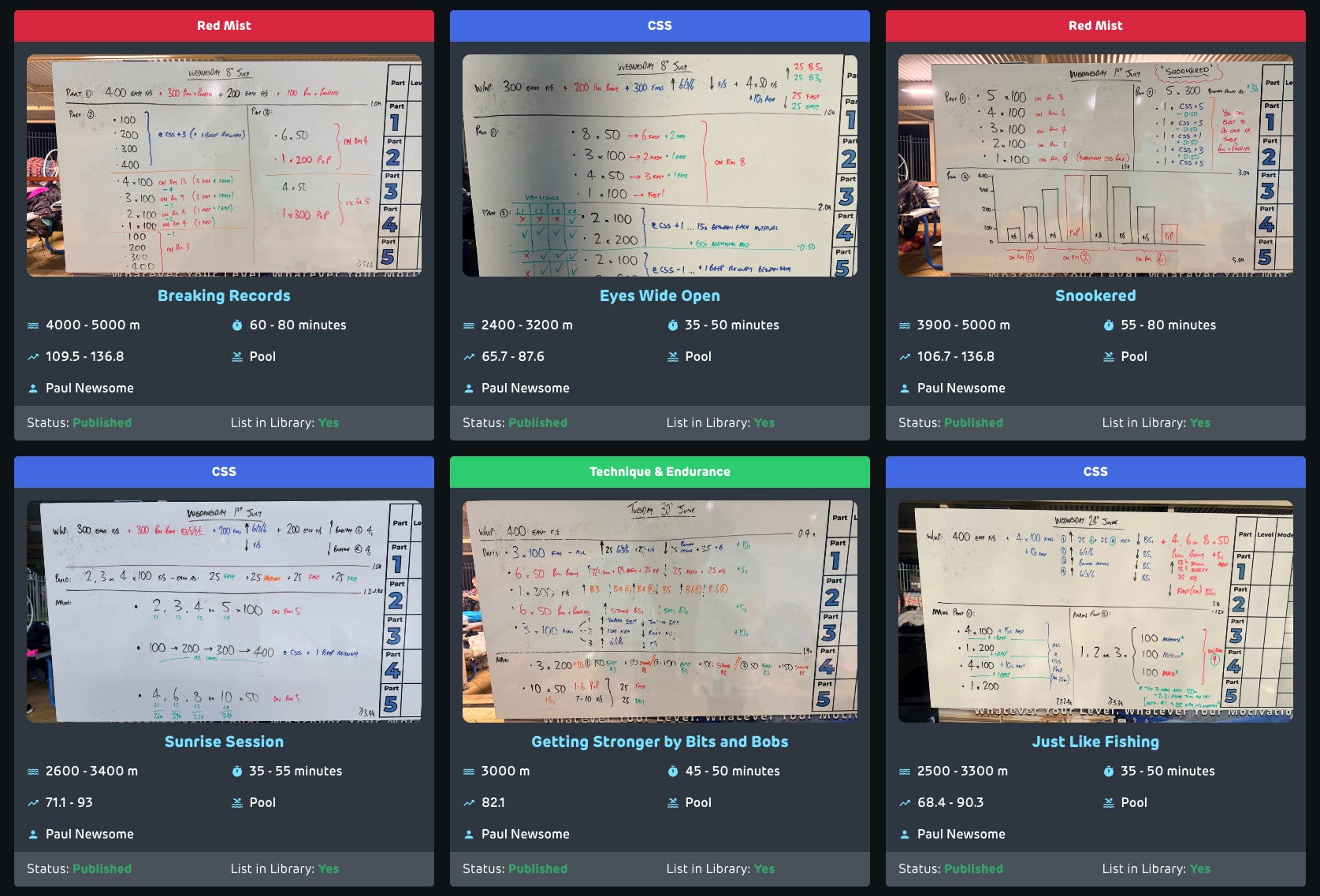
Within the SwimSmooth GURU, we quantify training using Swimming Training Stress Score (sTSS). It’s a measure of the overall training load from each session, taking into account both duration and intensity relative to your Critical Swim Speed (CSS).
As a guide:
A one-hour technique session might score 35-45 sTSS, whereas a more challenging Technique / Endurance session might take you closer to 75-85 sTSS.
A CSS development session will often score around 65-95 sTSS.
A demanding one-hour Red Mist session covering around 5 km may reach 120 sTSS or more.
Longer open water swims of 8-12 km can accumulate substantially higher scores again.
The temptation is to think that if harder sessions build fitness faster, then simply doing more of them must be the answer.
Unfortunately, that’s exactly how many swimmers end up overtrained, injured or sick.
Fitness isn’t actually built during the training session itself. It’s built during recovery.
That’s why the GURU displays three simple metrics that work together:
Fitness (blue) shows the long-term adaptations you’re accumulating.
Fatigue (pink) reflects the short-term cost of your recent training.
Form (green) represents your freshness and readiness to perform.
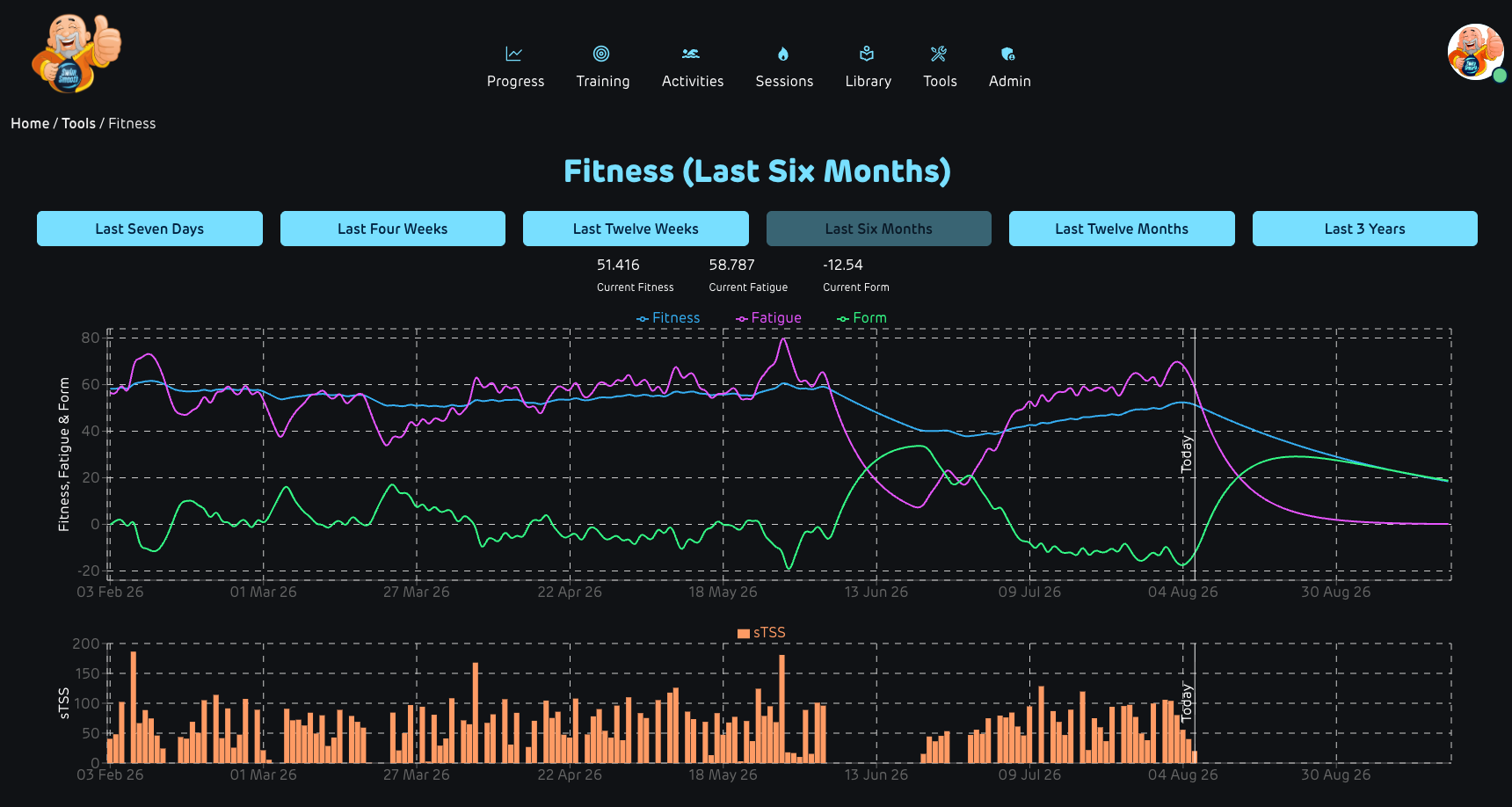
As fatigue rises, form naturally falls. Push that imbalance for too long and eventually something has to give. Sometimes that’s simply slower performances. Sometimes it’s injury. Sometimes, as I experienced this year, it’s illness.
This is also why tapering before an important race works so well. During the final 10-14 days before your event, you’re no longer trying to build more fitness. Instead, you’re allowing fatigue to fall while preserving as much fitness as possible. Your fitness may plateau, or even dip ever so slightly, but your form begins climbing, leaving you feeling fresher, stronger and ready to perform when it matters most.
I’ve written before about the importance of patience when returning after illness or an enforced break from swimming. The biggest mistake I see is swimmers trying to regain everything in the first week back.
Your body simply doesn’t work like that.
If anything, this chart has reminded me that consistency is far more powerful than intensity. The decline happened quickly, but the rebuild has required patience, discipline and trust in the process. There haven’t been any miracle sessions—just one good swim after another.
That’s perhaps the biggest lesson of all.
Don’t become disheartened if illness, injury or life gets in the way of your training. Your fitness will come back. It simply asks for the same thing that built it in the first place: sensible, consistent training over time.
So if you’ve recently had some time away from the pool,
don’t judge yourself against where you were before. Judge yourself by whether today’s session is moving you steadily in the right direction.
Because while fitness may disappear surprisingly quickly, consistency will always win it back, and your Swim Smooth Coach is primed to helping you do exactly that!
Thanks for reading.
Your coach,
Paul

