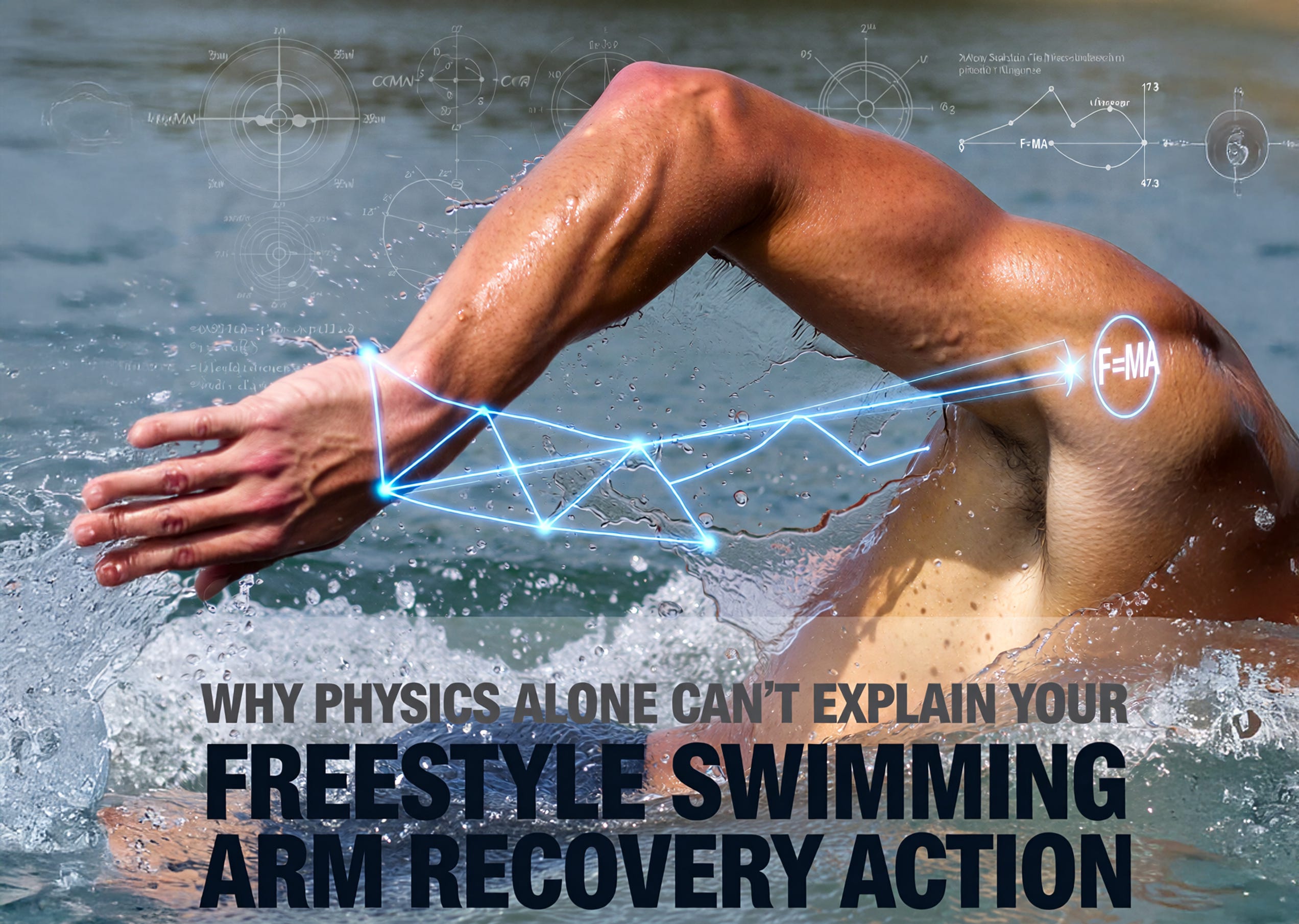
Why Physics Alone Can’t Explain Your Freestyle Recovery...
(A respectful reply to last week’s feedback)
Hey Swimmers,
Last week’s blog on arm recovery prompted some excellent discussion - including a detailed response grounded in physics and the principles of angular momentum.
It’s the kind of thoughtful engagement that makes writing these posts so rewarding.
Interestingly, this same line of thinking often appears in practical coaching settings too.
During a clinic I ran on Sunday in Kuala Lumpur, Malaysia with the team at My Swim Coaching, more than half the group showed clear tendencies toward over-gliding, believing it to be the more “efficient” way to swim. Their speeds had plateaued for the very reason this misconception persists: an idea that makes sense in theory, yet falls apart once biomechanics and real human movement enter the picture.
Before diving into the feedback itself, it’s worth highlighting something central to how we understand movement in sport.
Swimming technique isn’t governed by a single scientific discipline.
It’s shaped by physics, biomechanics, and applied coaching practice - the combination that sits at the heart of Sport & Exercise Science. This multidisciplinary lens is something I’ve been immersed in since my degree at the University of Bath in the late nineties and through more than two decades coaching thousands of swimmers around the world.
What makes applied sport science so exciting is this exact blend: physics gives us the rules, biomechanics tells us how the human body expresses those rules, and coaching brings the two together in the water with real people - each with their own movement history, strengths, limitations, and tendencies. Just like last week’s case study swimmer, Gerry (which you can read here if you missed it):
With that context in mind, here is the message shared by one of our readers, Philip:
“I just want to say that there is a reason why bent arm recovery IS more efficient, especially on long swims.
If you sit in an office type swivel chair and spin yourself round with your arms out wide, you will notice that the chair speeds up when you draw your arms into your body. This is a demonstration of the conservation of angular momentum.
There are thus two reasons why a straight arm recovery is non-optimal:
(1) It takes more energy to impart angular momentum to a long lever than it does to a short lever…
(2) …your hand flies forward on its bent arm with no further energy input. That’s what ballistically means… A pull–rest cycle allows you to swim for longer with less tiring of the muscles and less use of glycogen.”Reference: Terry Laughlin. Hope you might consider this insight useful.”
Philip - thank you. Thoughtful, well-reasoned feedback like this strengthens the conversation for everyone. And you are absolutely right on one key point: the fundamental laws of physics apply to all swimmers, all of the time.
But - and this is the heart of this week’s article - physics alone cannot tell us how a human body should move through the water. That part belongs to biomechanics.
Where Physics Meets Reality: The Biomechanics Bridge
Angular momentum, lever lengths, and energy expenditure are all valid principles.
No argument there.
But biomechanics governs how the body expresses those principles. That means joint range, tissue tolerance, motor patterns, postural habits, flexibility, and the small asymmetries every human carries.
This is why two swimmers can attempt the same “optimal” recovery shape and experience completely different outcomes:
One may gain efficiency.
Another may feel impingement in the shoulder.
A third may lose rhythm or timing.
A fourth may tighten through the neck.
A fifth — like last week’s example Gerry, may find herself fighting her own body just to achieve the supposedly “correct” position.
Physics explains forces.
Biomechanics explains movement.
Swimming technique is the interplay between the two.
Why Some Swimmers Shouldn’t Bend Their Arm Too Much in Recovery
This is where we differ slightly from a universal, physics-first model.
When I suggest opening the recovery, softening the elbow angle, or allowing a straighter swing for certain swimmers, it’s not to contradict physics. It’s to acknowledge something physics doesn’t account for:
The variation in human bodies.
For example:
A swimmer with reduced shoulder external rotation may find a compact recovery painful or unstable.
Someone with pronounced thoracic stiffness may struggle to keep the elbow high without additional discomfort.
A swimmer with a naturally faster stroke rhythm (many Swingers, for instance) gains fluidity and connection from letting the arm recover more freely, even straighter.
And a newer adult swimmer with limited aquatic experience may simply relax more - and move more naturally - with a less constrained path over the surface.
We’ve made these adjustments for thousands of swimmers, often with instant improvements in rhythm, comfort, and sustainable speed.
That doesn’t contradict physics.
It respects biomechanics.
A Note on the “Ballistic Recovery” Argument
Philip’s description of using momentum to “rest” during recovery is an elegant idea - and it works beautifully for some swimmers.
But it requires:
excellent timing
excellent shoulder mechanics
excellent control of hand path
stable rotation
high proprioception
low muscular tension
confidence in open water or bumpy conditions
Most adult swimmers - including the majority we coach - do not possess all of these characteristics. And forcing a ballistic pattern often leads to:
dropping the elbow underwater
crossing the midline
shoulder fatigue or impingement
instability when sighting or breathing
timing breakdowns
excessive vertical movement
So again:
Physics explains what could work.
Biomechanics reminds us what will work for this swimmer, right now, in their body.
Why This Matters to Swim Smooth Coaching
Every week I see swimmers transformed not by chasing an idealised recovery shape, but by finding something that suits their anatomy, their rhythm, and their level of experience.
Gerry’s story last week is one example.
There are thousands more behind it.
And this brings me back to the core message of this week’s blog:
This is exactly why Swim Smooth coaches focus on coaching the swimmer, not the stroke. We work with the body in front of us, respecting anatomical limits and natural movement tendencies, and shaping technique that delivers the best performance for that individual - not for an idealised model.
If you’d like your technique analysed through this lens - human, individual, evidence-based - you can find your nearest Swim Smooth Coach at:
See you next week!
Your Coach, Paul


