

Hey Swimmers,
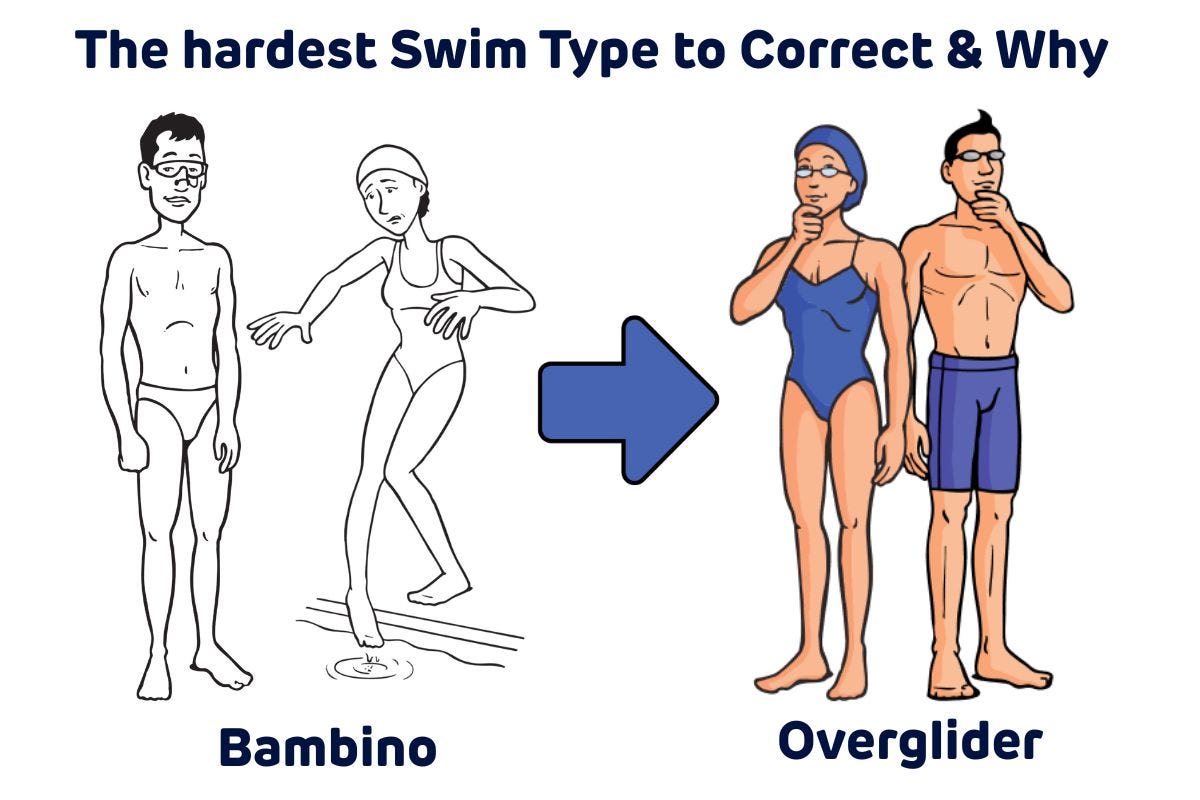
If there’s one stroke pattern that consistently proves the hardest to correct, it isn’t because the swimmer lacks effort, fitness, or even commitment. It’s because of a well-intentioned over-correction that quietly rewires their timing. I’m talking about the Bambino who becomes an Overglider.
Let me explain why this happens, why it’s so common, and most importantly, how to fix it.
The timing spectrum at the front of the stroke
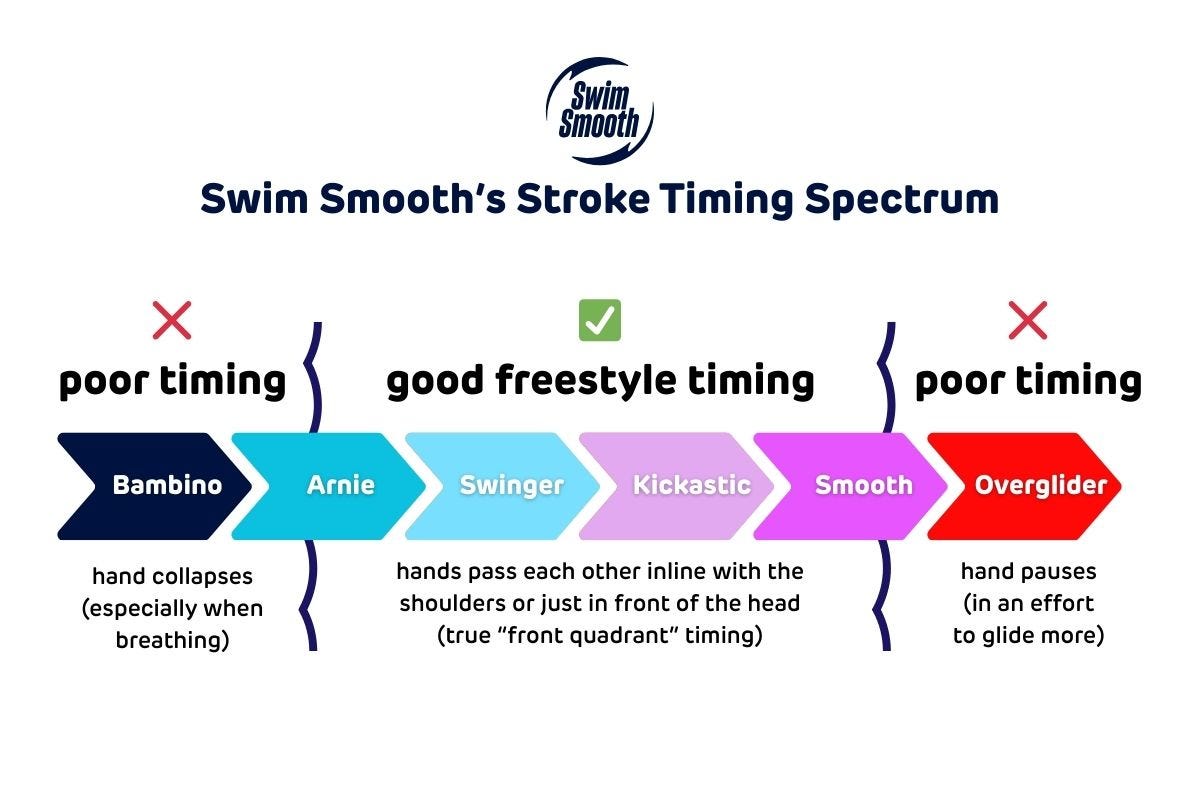
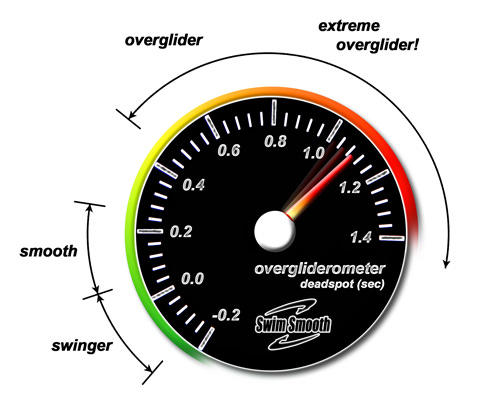
One of the most important ideas to understand in freestyle is that stroke timing exists on a spectrum. Specifically, where the hands pass each other in front of the head.
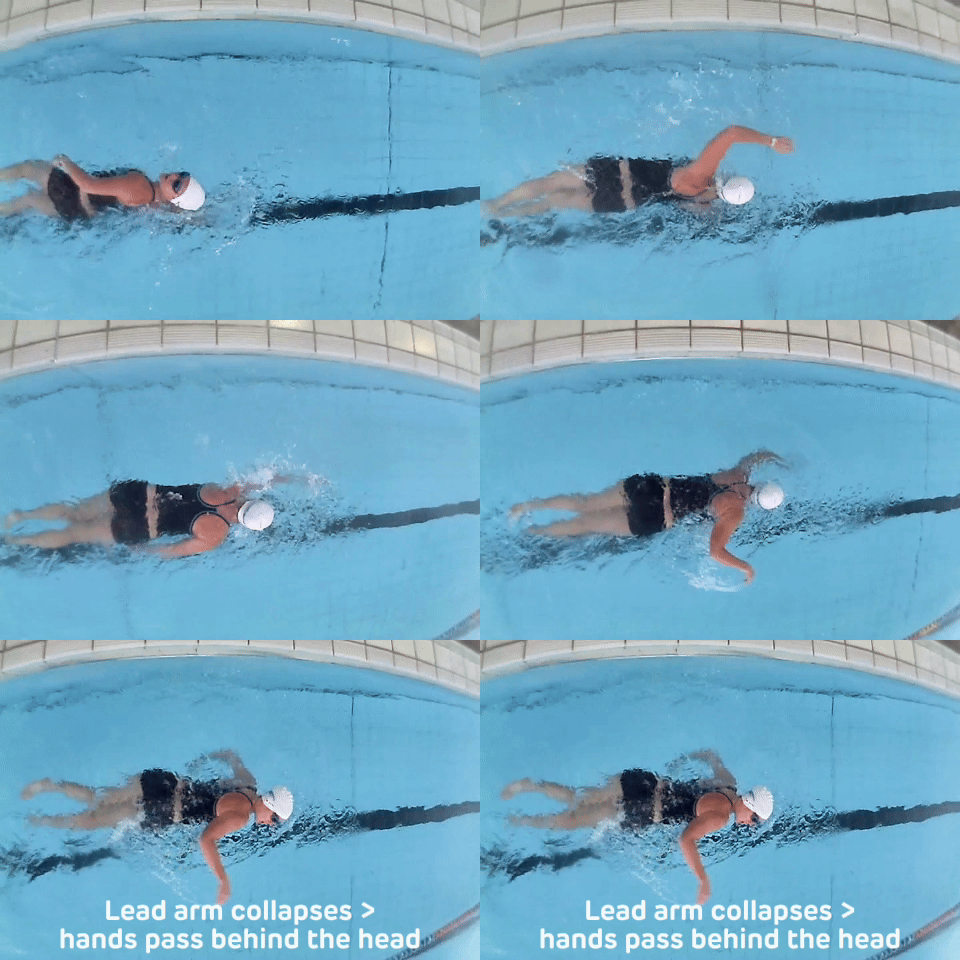
At one end of the spectrum, we have swimmers who drop their lead arm too early. This is classic Bambino behaviour. The lead arm collapses as they turn to breathe, leaving them unsupported. The breath feels rushed, unstable, and uncomfortable. Swimming often hasn’t been part of their life since childhood, so their kinaesthetic awareness in the water is still developing.
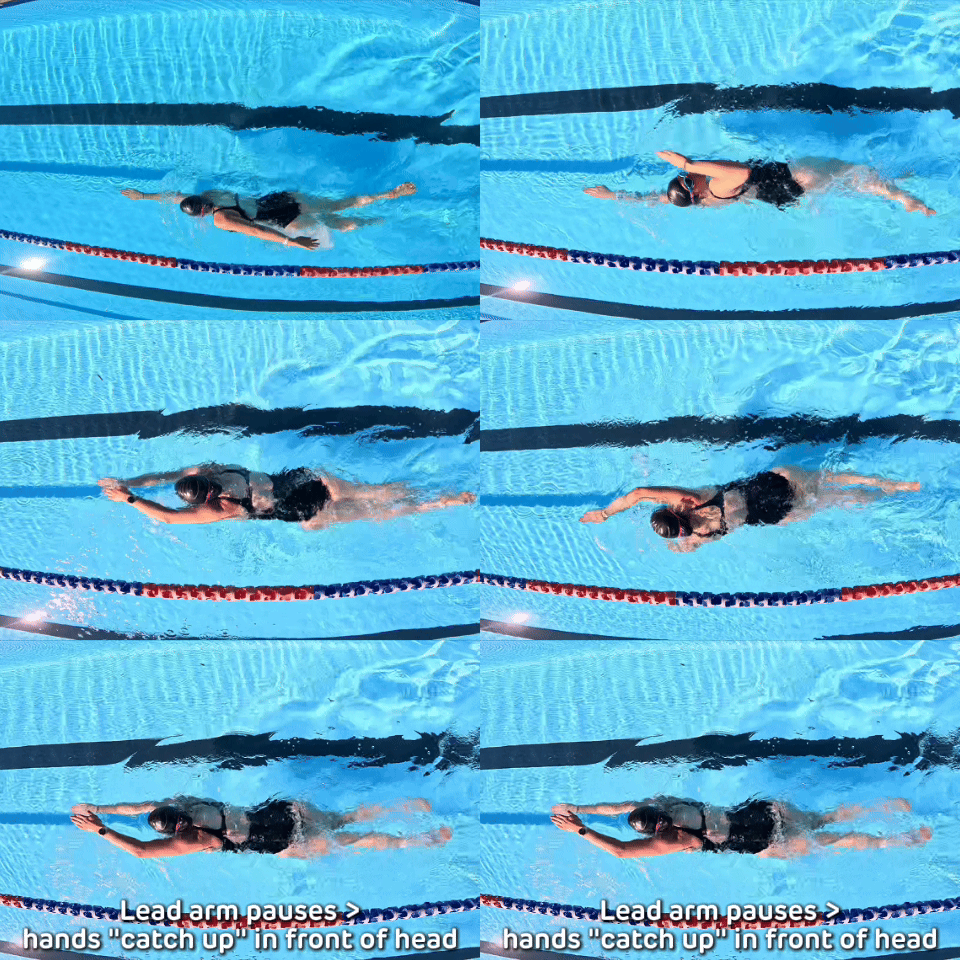
At the opposite end of the spectrum, we have Overgliders. These swimmers leave the lead arm extended too long, often waiting until the recovering arm almost catches it up. The stroke looks smooth and calm, but there’s a dead spot at the front where momentum disappears.
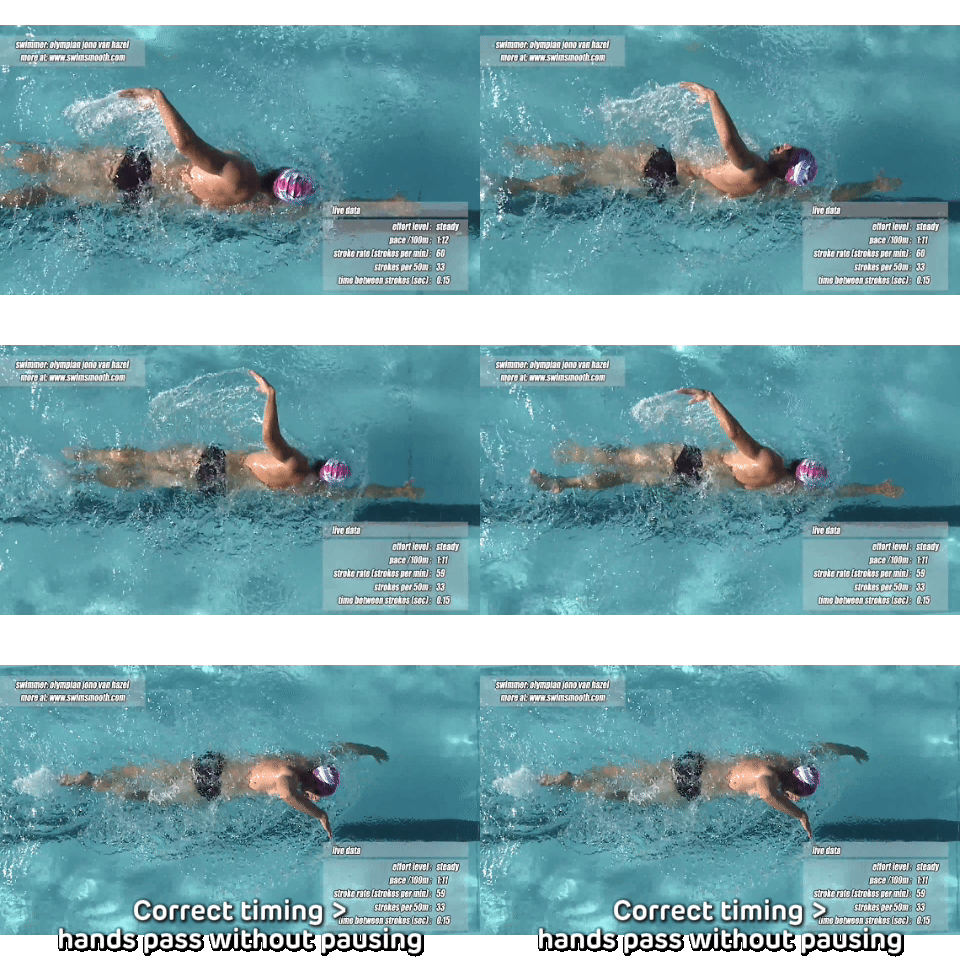
Somewhere in the middle sits what we’re aiming for. The hands pass each other smoothly in front of the head without collapsing or pausing. Continuous motion. No dead spot. This is the hallmark of a Smooth swimmer, beautifully demonstrated by Jono Van Hazel, the model for Mr Smooth himself.
How Bambinos become Overgliders

Here’s where things get tricky.
When a Bambino struggles with breathing due to the lead arm dropping too soon, the traditional coaching fix is often to say, “Hold your arm out longer.” In the short term, this works. The swimmer feels more supported. The breath becomes easier. Everyone breathes a sigh of relief.
But over time, that fix becomes a habit.
The swimmer doesn’t just hold the arm a little longer. They wait. The lead arm becomes static. The hands meet. A catch-up stroke is born. Momentum stalls, and the swimmer subconsciously recruits the legs or rushes the pull to restart the stroke.
This is exactly what we saw with Mable and Judy in Kuala Lumpur. Both showed clear signs of having once dropped the lead arm too early. Both had been coached, sensibly at the time, to wait longer. And both had drifted too far along the spectrum into over-gliding, complete with dead spots, slipping catches, and reactive leg kicks.
It’s no coincidence that 7 out of 12 swimmers in that clinic showed Overglider traits. Over-gliding is baked into how freestyle has traditionally been taught for decades. Fewer strokes. Longer glide. More “efficiency”. The problem is that efficiency without momentum is an illusion.
Why this swim type is so hard to correct
Over-gliding feels right. It feels calm. It looks good on video. And for Bambino swimmers, who often lack confidence and coordination in the water, it feels safe.
Removing the pause can initially feel messy. Busier. Even wrong.
That’s why this is the hardest pattern to fix. Not because it’s complex, but because it challenges what the swimmer believes good freestyle should feel like.
How to identify if this is you
Before trying to fix anything, it’s important to recognise the pattern for what it is.
You may have drifted from Bambino towards Overglider if the following feel familiar:
Your hands almost meet or briefly “wait” for each other in front of your head.
There’s a noticeable pause before the catch begins.
Breathing feels easier when you slow the stroke down, but harder when you try to swim faster.
Your legs kick harder or bend more during the breath, especially on one side.
You’ve previously been told to “hold the lead arm out longer” to stop it dropping.
If you recognise yourself here, it’s worth emphasising this: nothing has gone wrong. In fact, you likely fixed an earlier problem very successfully. The issue is simply that the correction has been taken a step too far along the timing spectrum.
How to move back towards better timing
The solution is not to rush your stroke or abandon length altogether. It’s to reintroduce continuity.
What we’re aiming for is not faster arms, but fewer interruptions. The hands should pass each other smoothly in front of the head, rather than meeting or waiting. That single change removes the dead spot where momentum is lost.
For many swimmers, especially former Bambinos, this initially feels uncomfortable. The stroke may feel busier or less controlled at first. That’s normal. You’re removing a safety mechanism that once helped you breathe and feel supported.
This is where the right drills and feedback matter. Exercises that:
Keep the lead hand in the water without freezing it,
Improve feel for the catch,
And gently guide stroke rate rather than forcing it,
allow the swimmer to experience flow without panic.
Just as importantly, breathing often improves as a consequence of better timing, not as a separate fix. When momentum is maintained, the body stays higher, the breath becomes calmer, and the legs no longer need to rescue the stroke.
This is exactly what we saw with swimmers like Mable and Judy. Once the pause at the front was addressed, everything else began to settle.
A final thought
The hardest swim type to correct is only hard because it was created with good intentions.
Someone once saw a problem and offered a sensible solution. The swimmer felt better. More stable. More confident. Over time, that solution quietly reshaped the stroke’s timing until a new limitation appeared.
The good news is that this isn’t a dead end. With the right understanding of where you sit on the timing spectrum, and a focus on restoring flow rather than forcing change, this pattern is not only fixable, it’s often one of the most satisfying to resolve.
When the dead spot disappears, swimming stops feeling like a series of separate actions and starts to feel like one continuous movement again. And for many swimmers, that’s the moment freestyle finally makes sense.
Thanks for reading,
Your Coach
Paul
