

Hey Swimmers,
One of the great things about open water swimming is that no two races are ever quite the same. The conditions change, the competition changes, and sometimes the smartest tactical decision isn’t immediately obvious.
Recently, Jim from England wrote in with an excellent question:
Is it faster to take the shortest possible line around a buoy, or a wider line that allows you to maintain your rhythm and speed?
It’s a question that every open water swimmer encounters sooner or later.
The Solo Swimmer’s Dilemma

If you’re swimming by yourself with no other competitors around you, the answer is usually quite simple:
Distance matters.
The shortest route around the buoy is normally the fastest route.
Many swimmers overestimate how much speed they lose making a tight turn. While there is some disruption to your rhythm, the extra distance involved in taking a wide arc is often greater than the speed benefit you gain from maintaining a smoother line.
Think of it like driving a car. You might carry more speed through a wide corner, but if that wider line adds several extra metres, you still have to swim those metres.
For a standard 90-degree turn, I generally recommend sighting well, approaching confidently, and making a reasonably tight turn around the buoy without coming to a stop or making any dramatic changes to your stroke.
The key is anticipation.
Many swimmers don’t lose time because of the turn itself. They lose time because they stop sighting, arrive too close to the buoy, panic, and end up breaststroking around it.
Racing Changes Everything
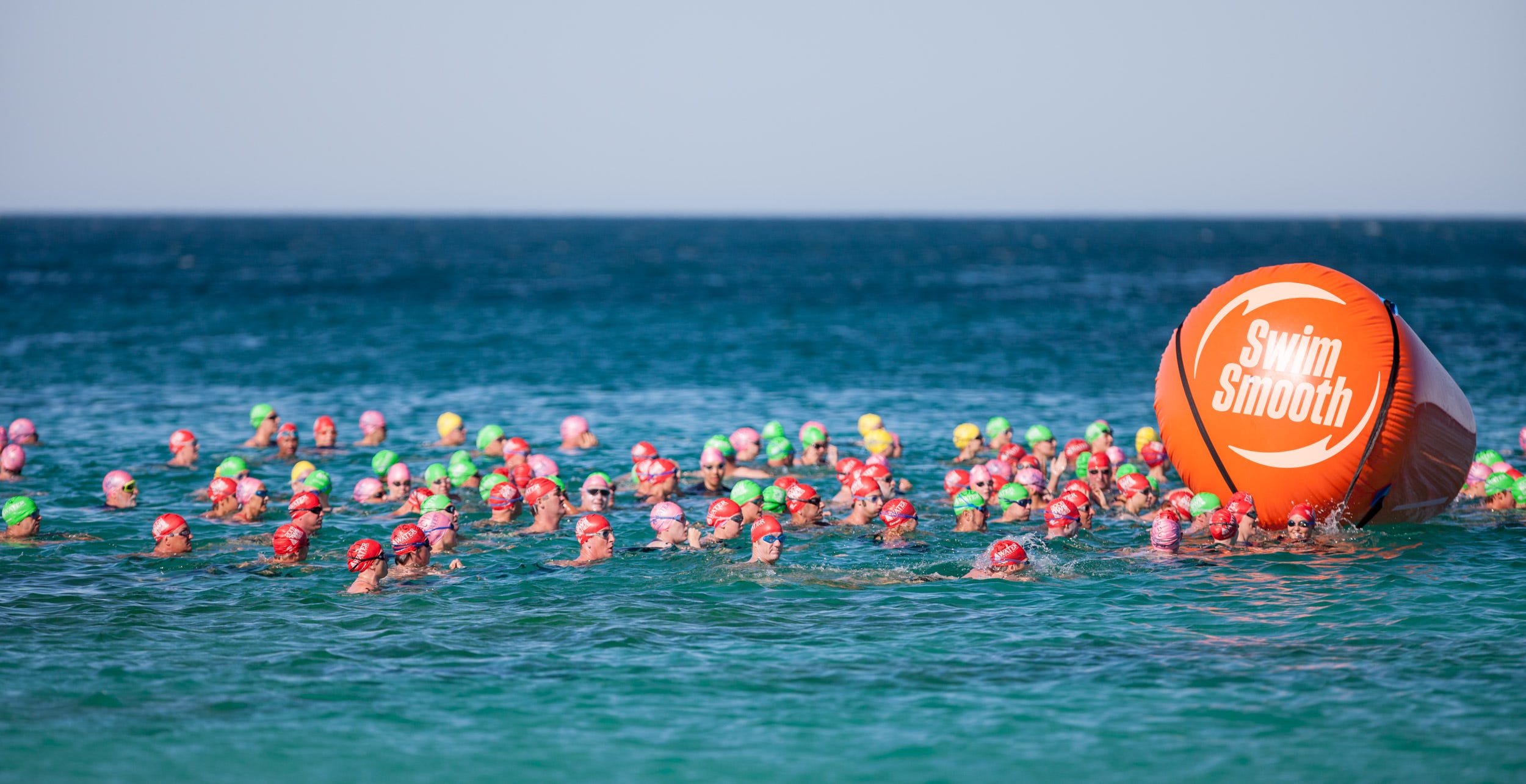
As soon as other swimmers enter the equation, buoy turns become far more tactical.
Jim’s second question was about finding yourself on the outside of another swimmer during a close race.
This happens all the time.
Imagine two swimmers approaching a left-hand turn buoy. The swimmer on the inside effectively owns the racing line. The swimmer on the outside is forced to swim a larger arc and inevitably covers more distance.
In this situation, trying to fight aggressively for the inside position at the last moment rarely works well. It usually costs energy, disrupts rhythm, and can sometimes lead to unwanted contact.
Instead, think several strokes ahead.
If you know you’re going to be outside, one effective tactic is to deliberately ease back half a body length before the turn, slot onto the swimmer’s feet as they round the buoy, and use the exit to re-establish your draft immediately.
This often costs less energy than trying to muscle your way around the outside and then sprinting to reconnect afterwards.
The “Slingshot” Effect

Experienced open water swimmers often use what I call a slingshot approach.
As you approach the buoy, maintain momentum and slightly increase your stroke rate through the turn. The goal isn’t necessarily to swim harder, but to avoid decelerating.
Most swimmers slow down at buoys.
If you can maintain your speed while others hesitate, you often emerge from the turn with a small but valuable advantage.
This becomes especially important on short multi-lap courses where you might negotiate dozens of turns throughout a race.
A one-second gain at every buoy soon adds up.
Practice Matters
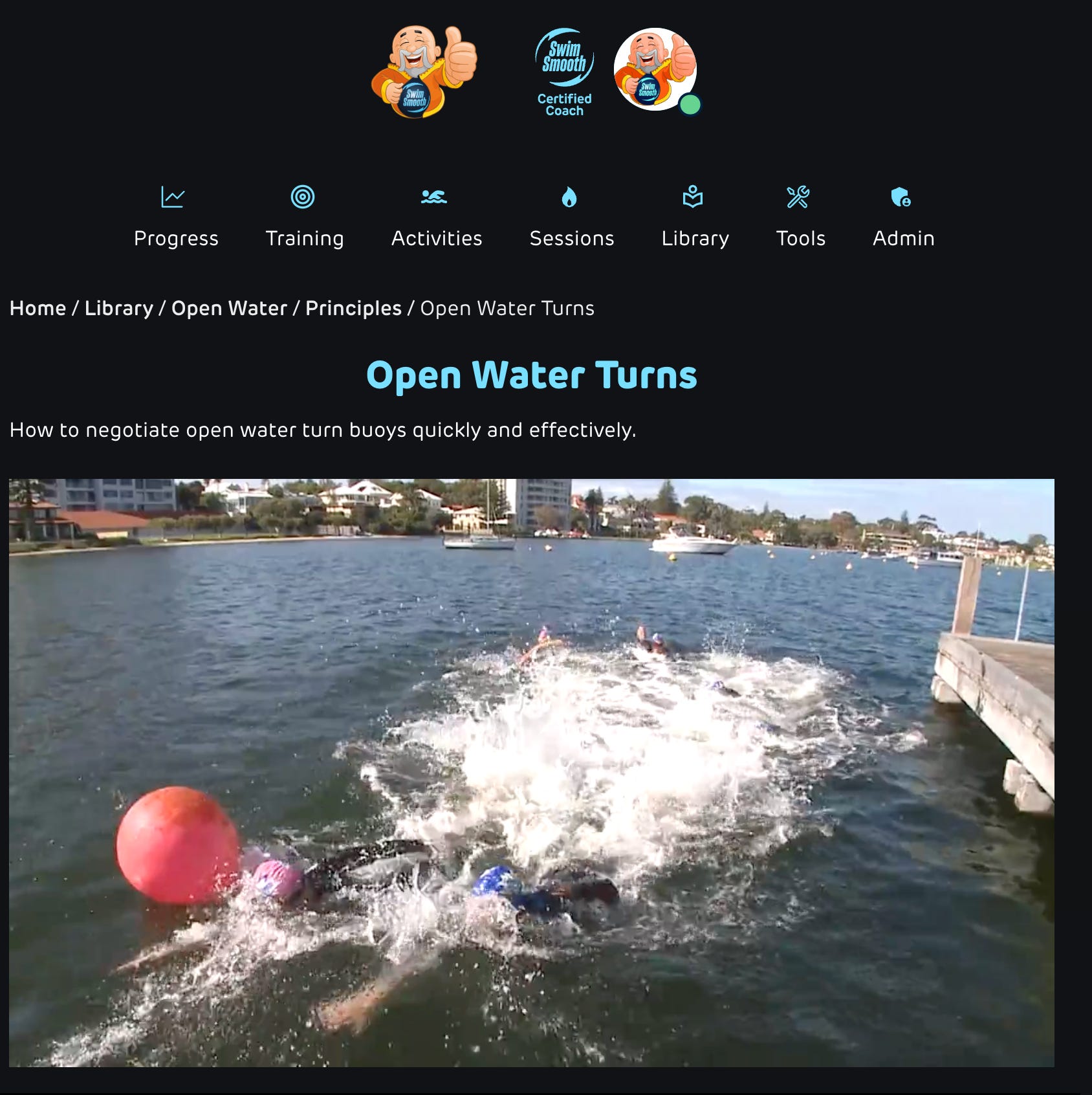
The biggest mistake I see is swimmers treating buoy turns as something that will magically take care of itself on race day.
Just as we practise starts, pacing, and drafting, buoy turns deserve dedicated training.
During our Swim Smooth Experiences and squad sessions, we often set up courses specifically to rehearse approaching, sighting, turning, accelerating, and re-establishing rhythm.
The more familiar these skills become, the less mental energy they require during a race.
And that’s often where the real gains lie.
Because the fastest swimmers aren’t necessarily the ones who swim the hardest around a buoy.
They’re usually the ones who lose the least speed while everyone else is slowing down.
Thanks for reading, your coach, Paul.
