"Please Don’t Film My Kick. It’s Terrible!"
The surprising confession of a 7-time world marathon swimming champion and what it means for your own swimming...
Hey Swimmers,
There’s a moment from 2010 that has always stayed with me.
We were filming underwater footage of Shelley Taylor-Smith, a seven-time world marathon swimming champion and five-time winner of the Manhattan Island Marathon Swim. A swimmer who, at her peak, set the standard for consistency, resilience, and world-class endurance.
And yet her first reaction?
“Why would you want to film me? I’ve got a horrible stroke!”
She doubled down moments later:
“Don’t film my kick. It’s terrible!”
That line… it’s perfect.
Because what you see in that footage is the complete opposite. Not a weakness. Not something to hide. But one of the most beautifully timed, efficient two-beat kicks you’ll ever see.
The Beauty of “Hardly Kicking”
Shelley’s kick is subtle. Quiet. Almost invisible if you’re not looking closely.
But it’s doing exactly what it needs to do.
Her two-beat kick is perfectly synchronised with her stroke. Each downward flick of the leg complements her body rotation and supports the catch. There’s no excess, no panic, no wasted energy. In marathon swimming, where efficiency is everything, this is gold.
It’s not about generating power from the legs. It’s about timing, balance, and rhythm.
And Shelley delivers this with absolute precision, just like Katie Ledecky, the most decorated American woman in Olympic history:
Where the Magic Really Happens
Here’s the key point that often gets missed.
You don’t develop a great two-beat kick by focusing on the kick itself.
You earn it through what’s happening at the front of the stroke.
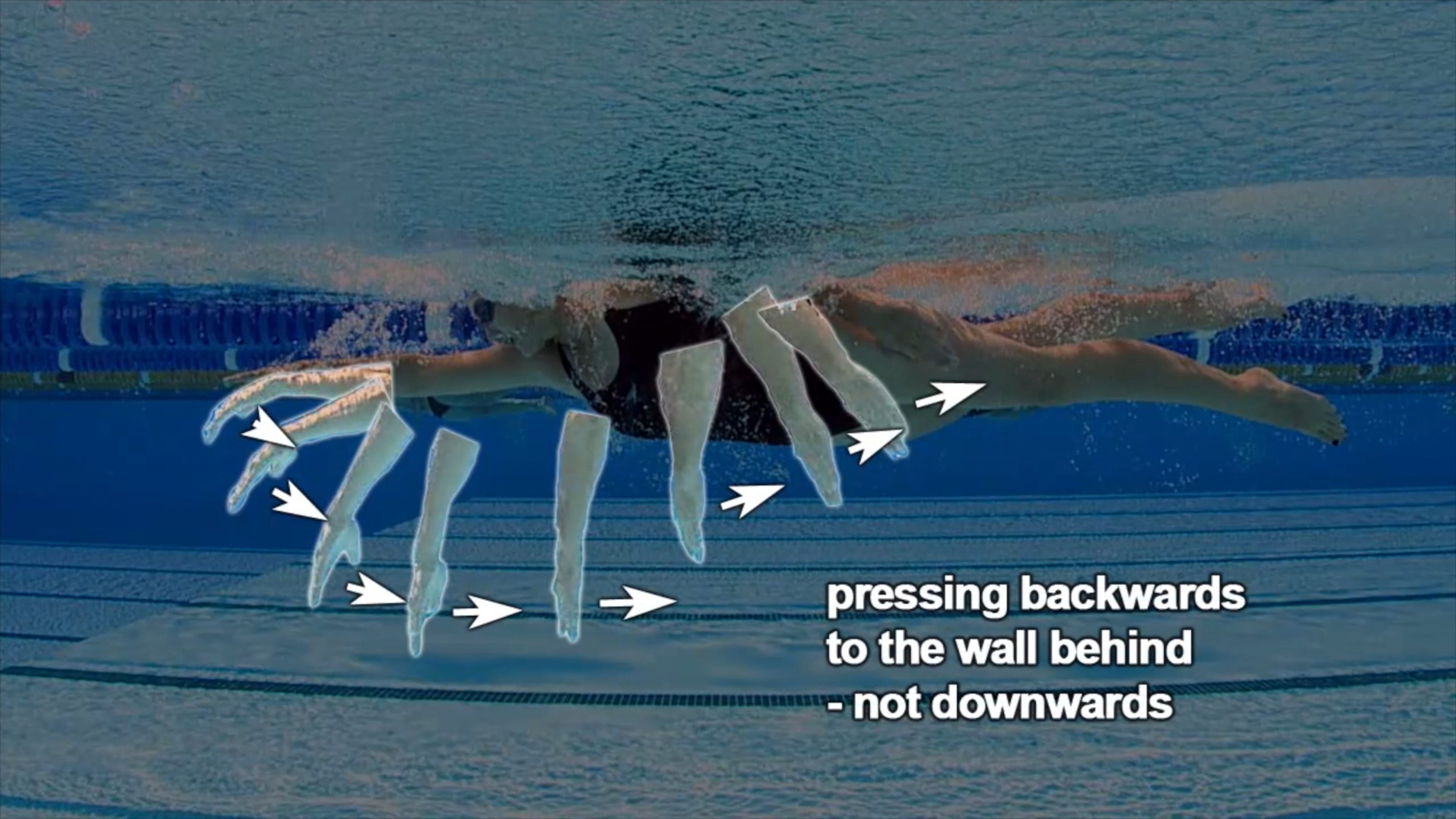
Shelley has an exceptional catch. She engages the water early, holds it, and drives it back with purpose. There’s no slipping, no collapsing through the elbow. That connection gives her stability and forward momentum.
Because of that, she doesn’t need to kick harder to compensate.
If your catch isn’t holding, the body instinctively looks for support. And that usually means over-kicking. Legs working overtime to make up for what’s being lost up front.
Shelley is the opposite.
She trusts her catch. And so her kick can remain light, precise, and beautifully timed.
No Pause, Just Flow
Another defining feature is her rhythm.
There’s no pause-and-glide. No overreaching. No hesitation.
She maintains a quick, consistent turnover that keeps everything connected. The stroke flows continuously, one movement feeding into the next. It’s seamless.
Watching it back, it’s hard not to think of ballet.
Everything is controlled, expressive, and quietly powerful.
A Lesson Worth Holding Onto
What Shelley called “terrible” is, in reality, world-class efficiency and it’s gone on to inspire countless endurance freestylers we’ve had the privilege of coaching over the last 25 years, like “Mega” Megan here:
It’s a reminder that what we feel in the water isn’t always what’s actually happening.
And more importantly, it reinforces a principle we come back to time and time again:
Focus on the front of the stroke. Build a reliable catch. Create rhythm.
Do that well, and the kick doesn’t need to shout.
It just quietly does its job.
Thanks for reading,
Your Coach, Paul.


